Friday, January 29, 2016

Fangirl Friday: Rupert Graves

For this weeks Fangirl Friday (of which there are already a ton penciled in), I’d like to take a minute and focus on Sherlock’s own silver fox, Rupert Graves.

Graves, who plays DI Lestrade on the popular mystery series,  saw his break-out come in the 1985 Merchant/Ivory classic A Room with a View. He followed that up almost immediately in 1986 with the Merchant/Ivory film version of the novel Maurice, in which he starred as Alec Scudder opposite James Wilby’s titular character.

My eyes were first opened to Graves’ work when I started watching Sherlock; however, it turned out to be one of those “Where have I seen that guy?” moments. Looking back through his filmography, he’s worked across a wide variety of genres with roles in V for Vendetta, The White Queen  and The Madness of King George. He has been wildly active since first breaking into film in the 1980s, and shows no sign of slowing down.


In following his career with open eyes, Graves has proven to be incredibly versatile. He moves easily from rougher, more villainous characters, to the wounded and fragile Edward Crecy in The Crimson Field or the surprisingly vulnerable Lestrade. All one has to look at is the (albeit brief) interaction between Sherlock and Lestrade in “The Hounds of the Baskerville” or the interactions throughout the whole series between Lestrade and Molly (Louise Brealey).

While you’re waiting for the hotly awaited (but disappointingly still a year away) premiere of Sherlock, viewers in the United States can can next see Rupert Graves on the ABC drama The Family, which premieres on local ABC affiliates on March 3, 2016.

Monday, January 25, 2016

The 1950s, Gender and the Music of Steve Lawrence and Eydie Gorme

Societal images of the 1950s create a vision of gender relations that are complex and evolving within American culture. It is common knowledge that during the second World War women flocked into the workplace to fill jobs vacated by men joining the armed services. However, with the end of the war and the reintegration of the servicemen, women were expected give up their jobs and return to their previous existence as housewives and mothers. Many of these women were ambivalent about giving up their jobs to return to domesticity. In this period of post-war American history there is a noted ambivalence towards women who chose to work. The musical career of Steve Lawrence and Eydie Gorme spotlights them not only as singing partners, but also in their personal lives as a married couple. Their close personal and professional association gives an interesting angle to their publicity which blurs the line between their private and public lives, and at the same time examines social gender expectations during this period of American history.

Steve Lawrence and Eydie Gorme were married in Las Vegas on December 29, 1957. The couple had met during their stint as performers on the Tonight Show, with host Steve Allen. The announcement of their marriage ran in the Los Angles Times the following day. The construction of the article is fascinating when considering and examining gender. The headline, "Eydie Gorme, Former Singing Partner Wed" shows that at this point in their relationship, Gorme was the more well known of the two. This is further verified in the opening paragraph, "Eydie Gorme, 25, television and night-club singer, was married here today to her former singing partner, Steve Lawrence, 21." What is also interesting when looking at this is the age difference between the couple. A male older than female relationship is commonly acceptable even in contemporary society. However, if the woman in the relationship is older than the man the partnership quickly becomes one of scandal and tabloid fascination. The apparent taboo of an older woman dating a younger man is even evident in the 21st century, and the coining of the term "cougar." In the more conservative middle of the 20th century, it is likely that this would have caused even more of a stir.

It seems, when looking at the subject of age in Lawrence and Gorme's publicity, with the exception of their LA Times marriage announcement, in many instances the topic their age is sidestepped. However, in the marriage announcement which ran in the Chicago Daily Tribune, it was reported that both were the same age, 22. In later articles, their ages are further reversed, making Lawrence older than his wife. Many contemporary sources verify that she was four years senior to her husband, when examining primary articles, it appears that this touched a nerve among journalists and as such is often omitted or lied about. The idea of a woman marrying a younger man is a drastic departure from accepted cultural norms as well as grants the female member of the couple tremendous agency, as a result this is a pattern which is seen as threatening in post war culture.

The couples publicity further changes as the years progress into their marriage. Early into the marriage, the agency Gorme is granted within the articles is striking. As the 1950s progressed into the 1960s and she gave birth to their first child, her role in their publicity changes. Early in their career together, she is defined by her singing career as well as her life before show business. On July 27, 1958, Don Paige wrote in the Los Angeles Times, "Eydie has had an interesting climb to the top...She started out to be a crisply efficient young businesswoman working as a Spanish interpreter with an export firm..." In the summer of 1958, Steve and Eydie were serving as the summer replacements for their friend Steve Allen. Paige writes, "Eydie Gorme... a petite package with a vocal range that can make a coloratura blink, is solidly holding her own (with husband Steve Lawrence) in the summer spot for vacationing Steve Allen...." In these write-ups, her marriage and partnership is secondary, while her talent and skills are valued.
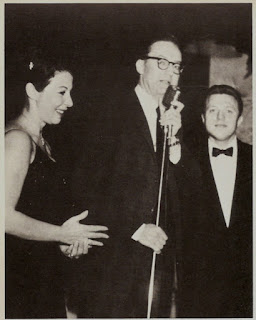
Her treatment in their publicity really changes after the birth of their first child in 1960. At this point, Gorme's role is redefined, emphasizing her domestic role rather than her professional life. In 1964 when her husband was appearing in the Broadway musical "What Makes Sammy Run," John S. Wilson wrote in the New York Times, "Mr. Lawrence's success in "Sammy" has temporarily stymied the night club career of his partner, Mrs. Lawrence. She is, however, occupied as wife, mother to their two sons, David 4, and Michael, almost 2, and mistress of their New York apartment." While earlier articles emphasized her identity as a singer and a performer, these later pieces define her identity solely in relation to her personal life as a wife and mother. While she is still a celebrity, it is no longer an important part of her persona. In a 1960 article by John Pagones, he writes, "Eydie has splendid Kirghiz eyes, a bodaciously proportioned figure that would make a chorus girl gnash her teeth with envy and the dark Semetic beauty that pashas must dream about...”. Our house is a mess...Steve was just discharged from the army, David was eight months old that day..." Besides the problematic wording, this quote further pigeon holes Gorme into her feminine, domestic duties, while her husband chiefly deals with the matters of their singing career.

While their publicity is affected by their personal lives, their act also incorporates elements of their marriage, commenting on and playing with stereotypes of matrimony. In a 1962 episode of the popular gameshow "What's My Line" when Steve was appearing on the panel, Eydie was brought in as the "Mystery Guest." When Eydie is exposed after a lengthy questioning process, during which her husband is seemingly fooled, Steve says: "No wonder you told me to get out of the house early tonight! Who is watching the children?" Host John Dailey chimes in, "When Steve left the house, Eydie was over the kitchen sink with her hair down..." After some further bantering, Steve asks, " I would just like to know how come you made it so fast now, but when we have to go out I always have to sit and wait two hours?" To which Eydie replies, "That's show biz." This is an example of the humor Steve and Eydie employed in their act. Within this moment, similar gender stereotypes which are present in their publicity are also present within their act. However, throughout their career, Steve is the most supportive of his wife's career. In Wilson's review of "What Makes Sammy Run" Lawrence says of Eydie, "For a housewife...she makes a hell of a living..." He is acknowledging her active role within their relationship. Eydie is not simply staying at home in the stereotypical position of the housewife, she is earning her own living.

The difference in publicity between husband and wife demonstrates the value of a woman's domestic life in the post World War Two era in American society. Eydie Gorme was a popular and successful nightclub performer, and throughout her early career, her publicity allows Gorme to assume an active persona relating to her professional life. Her career is interesting, in her close personal and professional relationship with husband Steve Lawrence, their publicity begins to blur their public lives with their professional lives. However, after her marriage and the birth of her children, the importance of this feminine duty overshadowed the success of her career, forcing her to take a back seat to her husband's career. In a study of these legendary performers, the societal hostility towards working women during the post World War Two era becomes strikingly apparent.

Friday, January 22, 2016

Martin Milner: A Darn Good Actor

I was cruising YouTube tonight and stumbled across the most adorable compilation video celebrating the career of actor Martin Milner. Now, unless you were watching television in the 1960's and 1970's or are a complete and utter nerd like myself... (My middle school years were spent lusting hard after Todd Stiles and Officer Pete Malloy)...there’s a strong likelihood that you have likely never heard of Martin Milner. After seeing this video, I feel compelled to pay tribute to a man who I consider to be one of the greatest, but unsung actors of the mid-twentieth century.

Milner's first screen appearance was in the 1947 film based on the popular book  Life with Father which starred William Powell and Irene Dunne. Milner, who was roughly sixteen at the time, played the role of "John Day" the second oldest son behind Clarence (Jimmy Lydon) from whose perspective the film adopts.

Milner worked steadily throughout the 1950's, appearing in dozens of the war films which flooded Hollywood in the years following World War Two. My personal favorite is Halls of Montazuma which features an all-star cast: Richard Widmark, Karl Malden, Robert Wagner, Richard Boone and Jack Webb. While Milner is still incredibly young and inexperienced in this film (especially compared to many of these seasoned, popular actors) his performance really stands out in the narrative. He gives a real sense of life to his character "Whitney," a young man trying to adjust physically and mentally to the horrors of wartime. In this role, his status as a youngster in the midst of this highly experienced cast really plays to his advantage. It is a powerful and stirring film, one that I highly recommend.

Between his varied film roles in the 1950's, Milner appeared in six episodes of the classic television series Dragnet starring Jack Webb. It is his partnership with Jack Webb that would provide the foundation for the later years of his career. Roughly ten years later in 1968, Milner was cast in the lead role of Officer Pete Malloy in Jack Webb's newest television series Adam-12. While Dragnet followed the day to day life of Sgt. Joe Friday operating out of (usually) the homicide division of the L.A.P.D., Adam-12 followed the everyday lives of the men in the uniformed patrol unit of the L.A.P.D. The narrative spotlighted the partnership of veteran Officer Pete Malloy and his partner Officer Jim Reed (Kent McCord), a rookie straight out of the police academy. Adam-12 was incredibly grounded in realism (Jack Webb consulted closely with the L.A.P.D. to ensure a sense of documentary like accuracy). While the narrative has been accused of being boring, the sense of reality that Webb strove to achieve serves as a testament to the strength of Milner's (and McCord's) acting. Both men were able to completely embody these characters from the dramatic action sequences, to the most banal of circumstances. The show, which ran from 1968 to 1974 ran toe to toe with Webb's other series Emergency! which chronicled the lives of paramedics and hospital workers in downtown Los Angeles. These shows created a mini environment on television, as the characters from both television series regularly crossed over to make appearances in the other. Milner was not a newcomer to television with Adam-12. 

In the early 1960's he starred in Route 66 opposite George Maharis and later Glenn Corbett. The show followed wealthy Todd Stiles (Milner) and Buzz Murdock (Maharis) as they drifted through the country on the famous Route 66. The show really was unique in that other than the presence of Todd and Buzz, there was very little consistency to the narrative. In each episode, the characters were in a different town dealing with different people. While Todd's beautiful car is better remembered than the show, the narrative allowed Milner the opportunity to further develop his acting. In each episode, he was faced with drastically different scenarios and was able to prove his versatility. Martin Milner was not simply a romantic lead, an action hero or a character actor. The varied narrative of Route 66 groomed him for the similar style of Adam-12.

It has been regularly documented in Hollywood that some of the most talented actors never receive credit for their work. Cary Grant never won an Oscar, neither did Richard Burton. Heck, how did Alfred Hitchcock never win an Oscar for his work. Throughout his forty year career, Martin Milner proved to be an incredibly talented and versatile actor. He could play a leading part, the second fiddle, and even the villain (Check out 1960's Thirteen Ghosts). His roles were never glitzy or over the top, he brought a sense of realism and likability to each part he took on.

My Favorite Martin Milner Roles: Check them out!

1.) Marjorie Morningstar (1958) Wally Wronkin
2.) Sweet Smell of Success (1957) Steven Dallas
3.) Compulsion (1959) Sid Brooks
4.) Halls of Montazuma (1950) Whitney
5.) Route 66 and Adam-12 of course!

Tuesday, January 12, 2016

Digging into the TV Archives: Rush (2009)

Hulu has proven to be a delightfully awesome source for Australian television. Since I can remember, I’ve always eaten up the dozens of television shows which seem to flood out of the United Kingdom, but I have never had the opportunity to explore beyond that tiny little corner of Europe. Well, Hulu changed all of that. One of my first discoveries was a little Australian police procedural, Rush. And it’s amazing.

Rush debuted in 2008, and follows the daily life and drama of a team of tactical officers working out of Melbourne. The nearest comparison I can make is to a S.W.A.T team. This group is typically called in when the situation is a level above that of the street level police officer. Rush ran for four season before ending in 2011.

I ate up the show, binge watching all four seasons in (what turned out to be) record time for your’s truly. There’s romance, drama, a hint of comedy, and lots of attractive men with Australian accents running around in police uniforms. (Sorry... let the schoolgirl in me out. Down girl!)

The stand-out performer to emerge from the show (at least for me) was Ashley Zukerman, who played young officer Michael Sandrelli. This was only the start of Zukerman’s career. American audiences might know him as Charlie Isaacs in the WGN period drama Manhattan (blog entry on this, soon to come). He also appeared in the blink and you miss it 13 episode run of NBC’s 2011 sci-fi drama Terra Nova. This writer has also been enjoying his work on The Code. I’m currently bingeing the first season of the Australian thriller, and Zukerman’s performance is award worthy, to say the least. (The first season is available on Hulu).

Rush actors Rodger Corser and Ashley Zukerman.
In my “Why Haven’t We Seen More of Them” segment, I would like to plead for more Rodger Corser on my television screen.  Corser plays Sr. Sgt. Lawson Blake and is the leader, mentor, (and sometimes love interest) for the team. Corser has been a mainstay on Australian screen’s, first appearing around 2000. Some greatest hits of his filmography: Underbelly, Puberty Blues and Party Tricks. He had a brief foray onto American television in the 2013 NBC hour long, Camp. The series was unfortunately short lived, ending after 10 episodes. (Miss. Fisher fans can see Corser as Captain Lyle Compton on season three, episode two of the series “Murder and the Maiden”). This writer would like to see more of this talented and charismatic actor. Hint... hint... Hollywood talent types.

This is just a brief write-up on a stellar show with an incredibly talented supporting cast. I could write pages on the work of all the performers, and there could be more to come from me on this. If you are a fan of police procedurals, I would definitely take a look at Rush. All four seasons are available for streaming on Hulu.

Monday, January 11, 2016

Please Be Good, Please Be Good: Lucifer (2016)

I have a lot of fangirl energy being spent on this show (which premieres January 25th on Fox... Hint... Hint). Am I being subtle enough? Okay, I’ll be a bit more blunt. Everyone should check out this show when it premieres.

Watching the previews for the midseason drama (procedural with fantastic elements), I find myself cautiously optimistic. The show's premise seems interesting, though Lucifer (apparently the devil himself) becoming entangled in a murder and running around LA with a female police detective worries me if it is not executed correctly. Fortunately, the series pulled in a diverse writing staff, bringing in writers with years of procedural experience on shows like CSI Miami and Graceland to shows with more fantastical narratives like Once Upon a Time in Wonderland and Tomorrow People to hopefully craft interesting and enticing stories.

At least from the released previews, the show appears to have a similar vibe to Constantine, the NBC drama, based on the DC comic book series,  which was the cancellation that broke so many hearts last season. I’m optimistic that the networks seem (at this moment at least) to be taking some more gambles in terms of content. They are playing around with some darker series' (The Following, anyone?); however, a lot of these shows are still not surviving long enough to hit their stride. It is the view of this writer, that the tight restrictions of the networks are still stifling shows that would likely thrive in the looser cable environment. As a midseason replacement, Lucifer has a very short time to catch on with viewers.

Getting back to fangirling...The main reason for my excitement... Tom Ellis. Plain and simple. Anglophiles with a Hulu subscription might recognize the Welsh actor as the ever-so-adorable, main love interest Gary from Miranda. 

Ellis has been floating around UK television for about fifteen years, appearing in shows like Miranda, Gates, and The Fades. He has been knocking on the door to Hollywood for a few years. Ellis played the title role in the 2014 USA network drama Rush, which had an unfortunate blink and you miss it 10 episode run.

Ellis has proven himself quite versatile, and this writer was estatic to see him get another crack at US television. His work in the UK is tough to find, and is largely restricted to the handful of series available to stream (pretty much all on Hulu). After doing some digging, Ellis has shown an ability to easily switch from the light (occasionally physical) comedy of Miranda to the heavier subject matter of apocalyptic drama The Fades or soap opera Eastenders.

Lucifer is slated to premiere on your local FOX affiliate on January 25, 2016. 

Sunday, January 10, 2016

Digging into the TV Archives: ‘Are You Being Served'

With today's entry, I'm digging a bit back into the television archives. 'Are You Being Served' ran on television starting into the mid-1970s and lasting into the 1980s on British television. 
How did I come to see it, you ask? Illicit late night PBS viewing (okay... It feels really illicit when you're 10 years old). ‘Are You Being Served’ and ‘Mr. Bean’
ran right after Charlie Rose.

Rewatching some of the early episodes, it’s easy to remember what it was that initially drew me to the series. ‘Are You Being Served’ follows the (usually zany) daily goings on of the ladies' and gentlemen’s department of fictional department store, Grace Brothers. The show combines quick and clever writing, with some of the most interesting and colorful characters in half-hour television.

From early in the first season, the characters are fully fleshed out, un-needing of the usual period of growth and development that so many shows are forced undergo in their early episodes. All one has to do is watch “Dear Sexy Knickers,” which is the second episode of the first season. This episode follows the almost farsical misadventures of Mr. Lucas (Trevor Bannister) as he attempts to get a note across to the ladies department to be read my Miss. Brahms (Wendy Richard). In the process, the note gets into the wrong hands, and the ladies must figure out who sent the note, and to whom it was meant for.

In a cast full of stand-outs, John Inman (right) leaps off the screen as Mr. Humpries. While his stereotypical performance can be interpreted as somewhat problematic in contemporary culture, it is fascinating to see a openly (and outwardly flamboyant) homosexual character on screen forty years ago. As anyone who takes a passing interest in classic film and television, homosexuality in this period would have been heavily repressed at the very least. At the it would actually be vilified. Neither of these are true. Inman's performance is very similar to what we saw in the character of Jack in 'Will and Grace' in the late 1990s. Mr. Humphries is an astute character. He is likable, and usually we find ourselves laughing with him, not at him.  

'Are You Being Served' is unfortunately much harder to stream. This writer would start with YouTube, and eventually purchase of Amazon if you like what you see.


Friday, January 8, 2016

Who’s Ready for Agent Carter?!

Last year, the success of Agent Carter was a very pleasant surprise for me. Prior to airing, it fell solidly into the category which Lucifer currently finds itself in. I desperately wanted it to be good, but was petrified of how it was going to turn out in what has been an increasingly weak line-up on the once strong networks.

Peggy Carter’s awesomeness struck me on a number of levels when I saw Captain America: The First Avenger. (I have always wanted to kick butt and take names in amazing World War II era fashion). It seems incredibly easy for the female lead in a superhero movie to take a back seat to the titular hero. In the case of this particular franchise, it would be easy to create a flat, generic love interest, as Captain America has 70+ years of available character history to fill a script. Thankfully, script writers Christopher Markus and Stephen McFeely didn’t just do the easy thing and write a blank archetype to swoon over Steve Rogers.

From her first scenes in the first Captain America film, Peggy stands out as an interesting and well-rounded character in her own right. While there are a number of instances of women involved in the various resistance movements in World War II, the stories of these women been largely ignored by popular culture, placing women into one of two archetypes, the housewife and Rosie the Riveter.

It is a tremendously important point that Peggy remains her own woman, even during the peak of her relationship with Steve. It is actually Peggy that introduces Steve to her world. We are shown throughout the two films that Peggy shared just as much (if not more) of a bond with Steve Rogers then she did with Captain America.

The first season of Agent Carter followed Peggy in the direct aftermath of World War II. Peggy is working for the Strategic Scientific Reserve,  through despite her impressive war record, she is treated more like a secretary.  The series, though more pulp serial than superhero series, has served as a well crafted origin story to what is currently happening in the Marvel Cinematic Universe. With the first season solidly under their belt, things should only get better with season two.

Be sure to turn in for the season premiere of Agent Carter on your local ABC affiliate on January 19th.